
Boyds Gunstocks Parts & Upgrades Rifles Stocks December 1, 2015
We found an easy and economical way to put a high-performance spin on our off-the-shelf bolt-action rifle. Best of all, you can do it, too!
Originally purchased in the late 1990s for an impromptu elk hunt, our Remington 700 ADL .270 has taken its fair share of game over the years. We have always appreciated the light weight of the synthetic stock, but never enjoyed the feel of cold plastic on bare cheeks during a frosty morning hunt or the noise it makes when sling swivels or pack buckles smack against it. In addition, the stock trigger is…well…a stock trigger. After shooting precision triggers in AR rifles for the last several years, the creepy clunkiness of the ol’ factory hook had become a noticeable liability in terms of tapping the rifle’s accuracy potential.
A few months ago, we decided it was time to do something about it.
The Path To Improved Accuracy
As many of you know, the road to rifle accurization has several avenues. Barrel quality and configuration, trigger design, muzzle crowning, bedding, braking, chambering, action design, stock configuration, ammunition load, and a host of minutia all contribute positively or negatively to achieving consistent point-of-impact (aka accuracy). You may also know that achieving the level of maximum accuracy usually means an investment that far exceeds the average working class budget.
So what is a shooting enthusiast or hunter to do if the wallet is dusty yet improving accuracy is high on the list? After much consideration, we boiled it down to two modifications that would make the biggest difference in boosting accuracy, and that we could do ourselves with simple hand tools: upgrade the stock and trigger.
Stock Upgrade

Our Boyds Featherweight Thumbhole stock features the Forest Camo color scheme, and came out of the box as you see it here. The rubber butt pad and sling swivels/bipod mounting studs came pre-installed.
Our choice of stock was a no-brainer. For years, we have known Boyds Gunstocks to be a premium source for custom laminated hardwood stocks. Available in a dizzying array of styles, colors, and firearm models, Boyds has stocks to meet practically every application and shooting style you can imagine. Moreover, if they do not have it, they’ll work with you to make it for you. Best of all, Boyds stocks feature precision CNC-machined inletting, so they are, in most cases, exact-fit drop-ins for the factory stocks they are replacing. This means that for most rifle models, you can do the work yourself—no gunsmith required.
Shooting over to the Boyds website, we used their “Find A Stock” menu to zero in on a model that would fit our rifle and our specific needs. The result was the Featherweight Thumbhole stock (#3U1820906110) in Forest Camo.
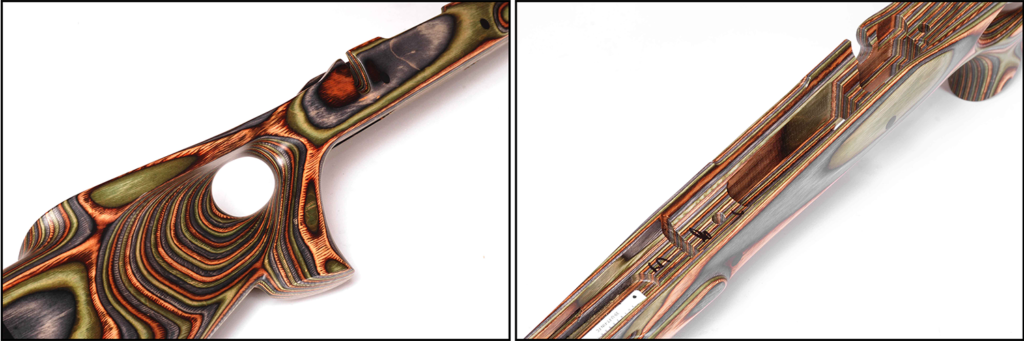
Ergonomics combine with precision CNC machining and a proprietary lamination/color treatment process to deliver a ready-to-assemble rifle stock that functions as good as it looks. The rollover cheek piece and contoured thumbhole grip provide comfortable hand and head placement to ensure proper sight alignment and trigger pull.
We selected the Featherweight Thumbhole model for two reasons.
First, since the .270 is our primary “light-skinned” hunting rifle, we wanted to keep the weight on par with the original factory synthetic model. Our factory stock weighs 2 lbs. The Boyds Featherweight Thumbhole stock weighs 2 lbs and 11 oz. Those 11 ounces won’t be noticeable when carrying the rifle afield, but that little bit of weight can make a big difference in stability when, for instance, we’re resting the rifle across a daypack to make a 200-plus-yard shot on a whitetail or antelope. (Accuracy Upgrade #1)
Second, having shot a few bench-grade competition rifles in the past, we knew that the thumbhole design would offer a more natural grip and promote a straighter trigger pull than the factory stock. (Accuracy Upgrade #2)
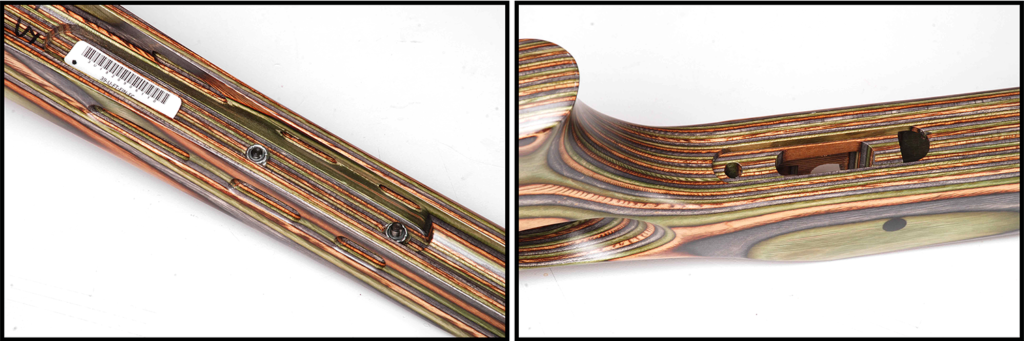
We expected to find some rough spots around the inletting, but were delightfully surprised at the exceptionally smooth finish even in the “hidden” areas. All Boyds stocks are made in the U.S. and machined and hand-finished at the company’s Mitchell, South Dakota, headquarters.
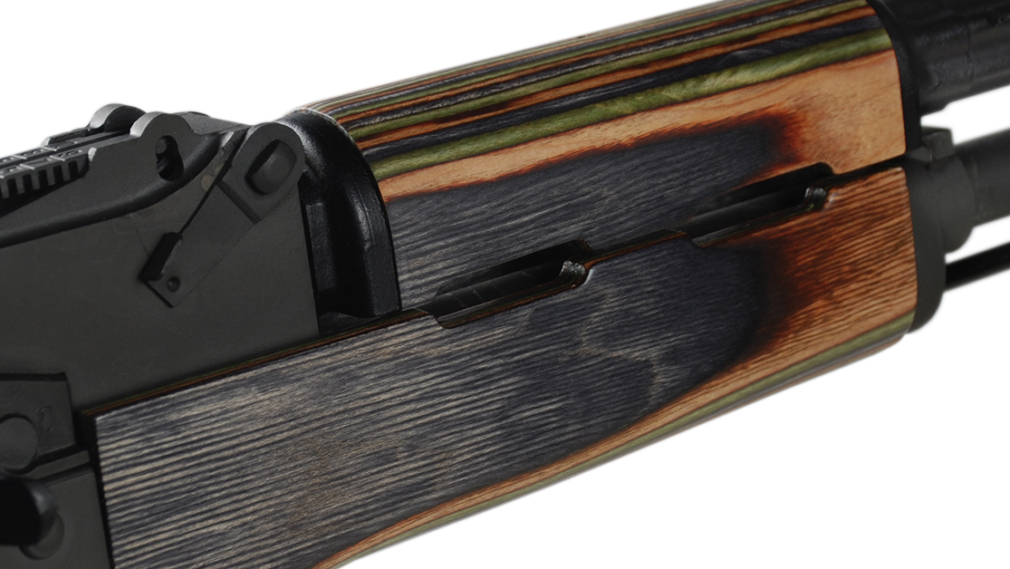
As for the Forest Camo color scheme, it seemed perfect for a hunting rifle. The alternating green, black, and rose color laminates deliver pleasing earth tones that not only look great, but also offer an ideal pattern for blending into natural environments—much more so than our black factory stock.
Speaking of laminates, anyone who knows woodcraft will tell you that laminated woods are much stronger and more stable than solid wood. This inherent strength and stability minimizes flex in the stock, especially when compared to factory synthetic stocks. Less stock flex equals more downrange consistency. Since we could not afford a professional bedding job, the Boyds laminated stock would give us another easy win. (Accuracy Upgrade #3)
Trigger Upgrade

With the choice of stock settled, we focused on the next big accuracy enhancer—the trigger.
Many things (all of them mostly bad) can happen between the time your finger touches the trigger to the time the trigger breaks. If you have never pulled back on a precision trigger, you may not even realize just how awful most factory triggers perform. Their typically long pull and less-than-smooth sear-to-trigger engagement provide numerous opportunities for you to muff a shot. A precision performance trigger eliminates those opportunities for bad things to happen. Pull back on a quality trigger and the gun goes boom as soon as you hit the weight necessary to break the sear engagement.
We chose a Timney #510 trigger to replace the Remington factory model. Timney is one of the most popular aftermarket trigger brands in the country, and their triggers are highly praised for their smooth, precise performance and easy installation. The #510 comes as a fully captured assembly, meaning there are no components to fit together during the installation. Simply pin it in place using the original front and rear trigger pins and you’re done. (Accuracy Upgrade #4)
The #510 is set to 3 lbs. pull from the factory. As an adjustable trigger, you can set it from 1.5 to 4 lbs. pull and fine-tune it to your particular shooting style. (Accuracy Upgrade #5)
Putting It All Together

Three screws secure the barreled action to the stock. Once removed, simply separate the stock and barreled action. Our stock Remington trigger was secured to the action by two trigger pins. With the pins backed out, the trigger came free.
We had never before replaced a stock or a trigger on a Remington 700, so diving into this operation came with some trepidation. As it turned out, there was no call for alarm. Three screws hold the stock in place and two pins secure the trigger. Two Allen wrenches (to remove the stock) and a small punch and hammer (to remove and replace the trigger pins) were all the tools required.
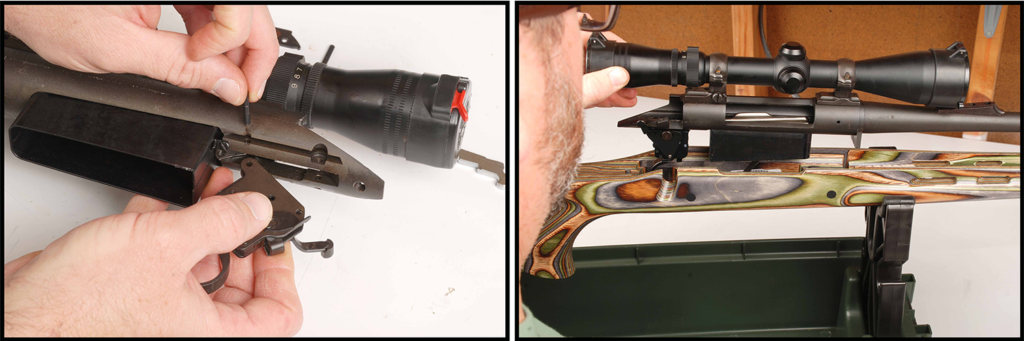
Our bolt stop configuration required us to remove the front trigger pin in order to remove the stock trigger. Some Remington trigger models do not require removal of the bolt stop. The new Timney trigger seated perfectly in the action, and aside from wrangling the bolt stop and spring back into place, installation was a breeze. Once the trigger was properly secured, the barreled action was ready for test-fitting in the new Boyds stock. Because of Boyds’ precise machining tolerances (0.020-0.040 inches on wood-to-metal fitment), everything went together without a hitch.
We mentioned earlier that Boyds uses a CNC machining process to form their stocks from solid laminated wood billets. This machining includes profiling the stock as well as inletting. The precision inletting afforded by the CNC machining means that, in most cases, the barreled action fits without the need for additional fitting. That was certainly the case with our barreled action.
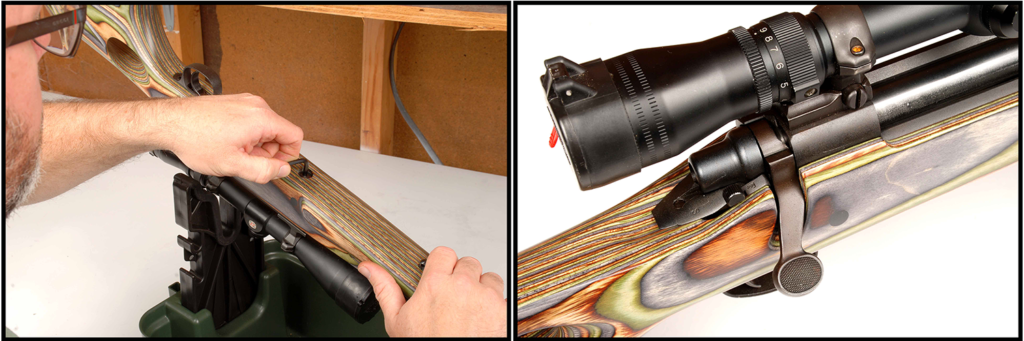
All of the mounting holes lined up perfectly with the holes in the barreled action. Thanks to the tight, precise tolerances built into all Boyds products, our “new” gun looks as if it was born with this stock.
Once we installed the new Timney trigger (here is an excellent tutorial on how to do that), the barreled action and trigger assembly dropped right in. No filing was required, and all screw holes lined up perfectly with the barreled action. Should we want to take the next accurizing step and bed the rifle, the Boyds stock is ready to go. The company machines its stocks with a 0.020- to 0.040-inch clearance between the wood-to-metal fit.
On The Range
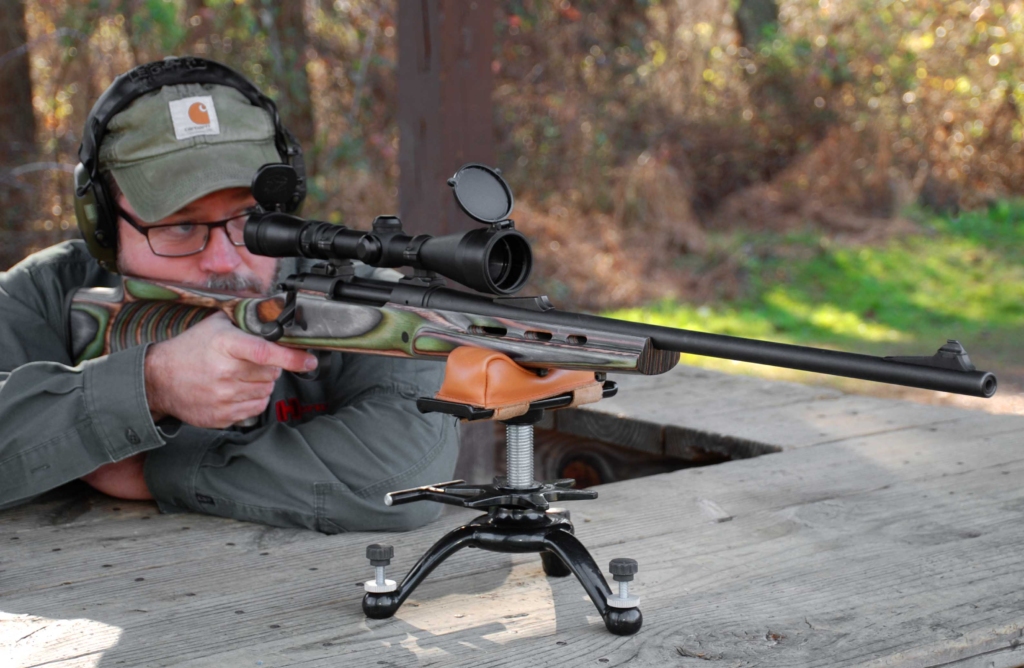
We would say that all the hard work paid off once we were able to test our upgraded rifle at the range, but that would not be entirely accurate since there was no hard work involved. Nevertheless, our investment did pay in the dividends that count—tighter groups. While we didn’t shoot our rifle on a sled, our three-shot group averages using off-the-shelf loads tightened up an easy 1/4-inch at 100 yards. That is a direct result of the cumulative benefits mentioned above by the addition of the Boyds stock and Timney trigger.
One final benefit that did not fully manifest itself until we hit the range was the trigger reach. The size and position of the stock’s grip allowed the pad of our finger to rest perfectly centered on the trigger—not in the joint. This is, of course, the ideal finger position needed for a clean pull. Whether this was by design or happenstance, we don’t know. What we do know is that the Boyds Thumbhole stock design forces a perfect hand position every time. (Accuracy Upgrade #6)
In The Field

Only days after upgrading and range-testing, our enhanced .270 proved itself in the field. We dropped this fine whitetail minutes after our season opened.
We gave our upgraded .270 a shakedown run three days before the opening of our rifle deer season. On opening day, 20 minutes after the break of dawn, a healthy 8-point popped onto the ridge near our stand. The buck was on a mission, wasting no time working its way through the undergrowth. At 60 yards, the deer paused just long enough to present a clear shot. The angle was awkward, but thanks to the always-correct hand positioning of the Boyds stock grip and the decisive action of the precision trigger, we made a quick, crisp shot and the buck piled up 40 yards later.
Conclusion
While we have shot $4,000-$5,000 custom rifles with custom loads, the cold reality is that this is a game best suited for someone else’s wallet. For those of us on a real-world budget who want to breathe new life into a trusted firearm and ramp up the accuracy potential (ours and our rifles’), a do-it-yourself Boyds stock and precision trigger upgrade can get the job done quickly and with grin-splitting result.
SOURCE – Boyds Gunstocks
Article Copyright 2015 by ArmedDaily.com; promoted by Boyds Gunstock Industries, Inc