
Automatic rifles Guns Parts & Upgrades Triggers Velocity Triggers August 19, 2015
All the AR-15 upgrades in the world won’t make a real difference in shooting accuracy until you make this simple, cost-effective upgrade.
Let’s face it. We can throw hundreds of dollars onto our AR-platform rifles and come away with a weapon that does this and does that and looks really cool. But at the end of the day, “Does the rifle shoot more accurately with all of those upgrades?”
Many things contribute to improved AR accuracy: a quality optic, an ergonomic pistol grip, precision-made free-float barrel…even the foregrip and buttstock configuration can make a difference, because anything that better adapts a rifle to one’s own biomechanics and shooting style will improve shooting form and thus increase accuracy.
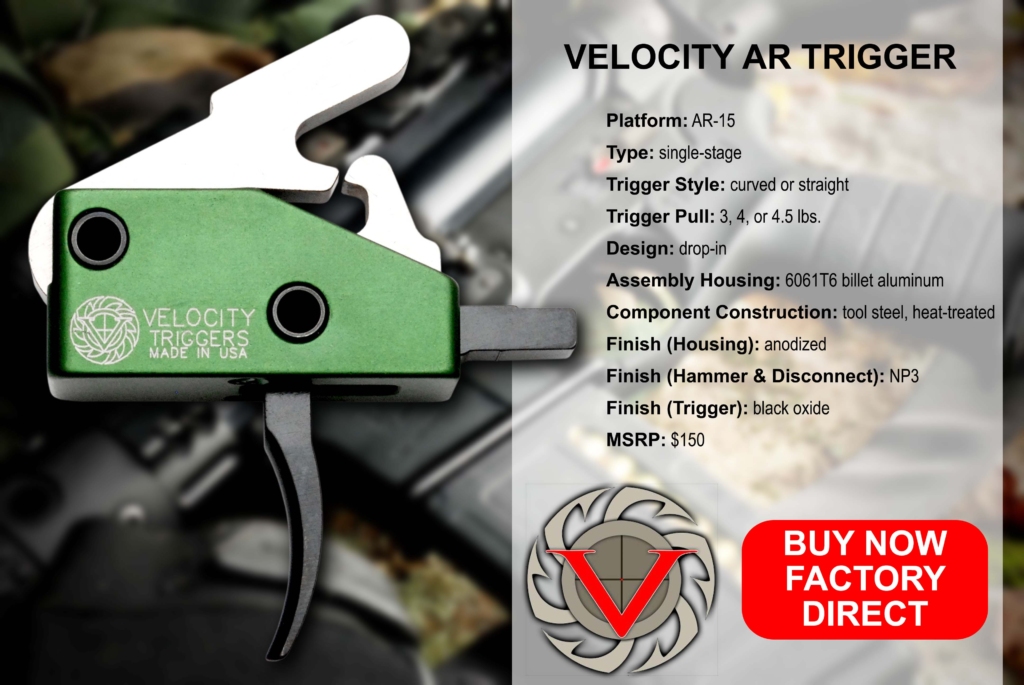
One upgrade that will give you the most notable jump in AR accuracy is a trigger. Likewise, the one thing that can negate whatever else you do to your AR to improve accuracy is…the trigger.
Everything that goes into your AR can impact shooting accuracy. An optic and quality barrel are big contributors to the plus side, so throw those in the hopper. A good grip, buttstock, and handguard can help, so in they go. Premium, consistent ammunition? Absolutely!
Now, at the very bottom of the accuracy funnel is the trigger, and it holds all of the AR’s additional accuracy enhancing components, waiting for the right moment to be unleashed. The trigger is the chute master, and how cleanly it releases the hammer to strike the firing pin…that’s all the marbles, right there.
A precision trigger can significantly boost a standard AR’s accuracy. A “parts-bin” MILSPEC trigger, however, can prevent an otherwise premium AR rifle from achieving its accuracy potential.
Why? It all comes down to shot disturbance.
If you’ve spent much time shooting stock or MILSPEC triggers, you know there is a considerable length of travel from the moment you begin to pull on the trigger until it “breaks” and the sear releases the hammer. Triggers with a long travel can cause you to extend the pause of the breathing cycle, leading to discomfort and opening the door for body movement and haste—either of which can throw off your sighting.
The same problems can arise with triggers in the 6-9 pound range because the more effort that is required to pull the trigger, the more your muscle mechanics change to compensate. This can alter the pressure points on your grip and the trigger hook, which can disturb your sight alignment at the moment the trigger breaks.
Finally, the material construction of the trigger itself can negatively affect accuracy. Stock triggers often feel “crunky” as the trigger sear engagement surface travels across the hammer’s cocking searation. This gritty, imprecise feeling may disturb the smooth release of the hammer and further disrupt your shot.
So, it doesn’t matter how good your barrel is, how much you spent on a quality optic, or how many cool widgets or doo-dads you’ve added to your rifle. If you’re running a stock, MILSPEC-type trigger, your AR will never achieve its full accuracy potential. Thus, it makes no sense to spend hundreds of dollars on “upgrades” that will provide only marginal performance gains until you make the upgrade that really counts.
The good news is, upgrading your AR with a high-performance “match-quality” trigger group is a simple process, and you don’t have to bust your budget to do it.
What’s that? You’ve already priced the premium triggers on the market and you think my budget must be bigger than yours?
Let me explain.
For several years I have shot single- and two-stage premium trigger groups from the top name in aftermarket AR triggers, and I can’t speak highly enough about their super smooth performance and accuracy potential both in CQB drills and long-distance target shooting. But these triggers were budget-crushers for me at the time, running around $225 to $250 each.
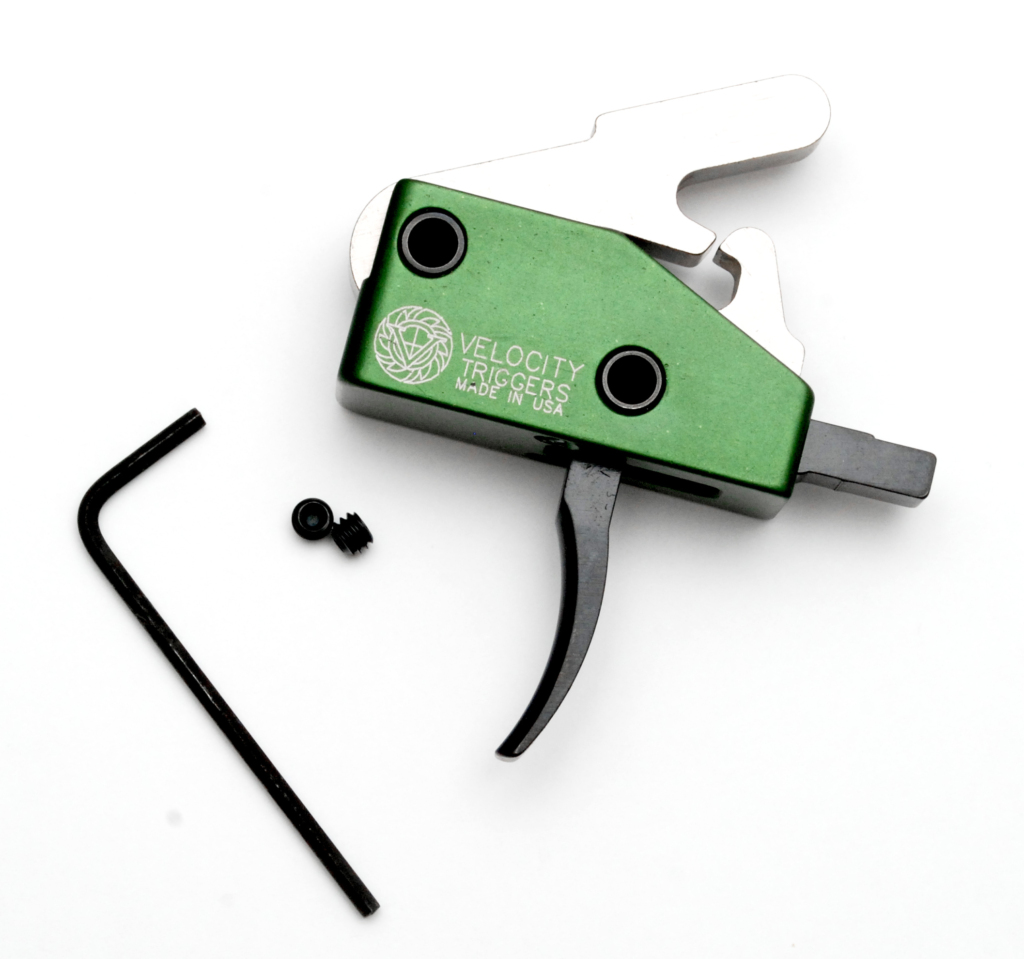
The Velocity AR Trigger is a drop-in replacement for any stock or MILSPEC trigger group. This is all there is to it…the trigger assembly, two set screws and a supplied Allen wrench.
Recently, I came across a company called Velocity Triggers. They make one drop-in-style trigger group for the AR platform, and they do it very well. This is a single-stage trigger assembly, and you can choose between a curved or straight trigger, and a 3-, 4-, or 4.5 pound pull, depending on the trigger style. Whichever flavor you choose, the cost is a flat $150 dollars. That’s a good $100 to $150 less than many competing trigger groups of equal quality and performance.
An aircraft-grade aluminum body houses the Velocity AR trigger assembly. The hammer, trigger, and disconnect are crafted from tool steel, and then honed, polished, and heat-treated. To further enhance durability and smooth performance, the hammer and disconnect are treated with NP3 by Robar, which is an electroless nickel-based finish that contains sub-micron particles of Teflon. The result is a high lubricity/low friction co-efficient surface that is corrosion-resistant and significantly reduces wear over the lifetime of the components.
Since the Velocity AR trigger is of a drop-in design—meaning the springs, hammer, trigger, and disconnect come pre-assembled and ready to install in your receiver—upgrading is a breeze. Even if you’ve never worked inside an AR receiver before, you can do this without breaking a nervous sweat.
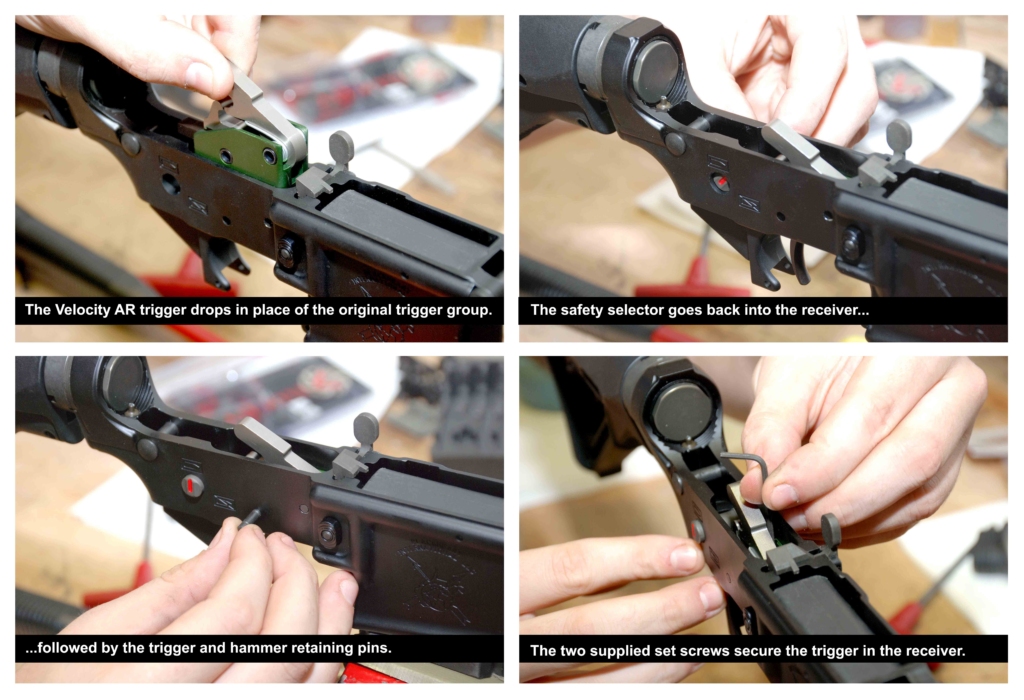
Installation overview of the Velocity AR Trigger. It really is this simple.
On the range, it took a while for me to get over the novelty of shooting a single-stage trigger, having been accustomed to shooting two-stage triggers for so many years.
My Velocity trigger came with a three-pound pull weight. Quite simply, you pull back on the trigger, and once you apply three pounds, the trigger releases the hammer. Try as I might, I could not feel even a frog hair’s width of trigger travel. You just go from 3 lbs. of pull to fire. Done.
The benefits of this are two-fold. First, zero trigger travel means reduced shot disturbance potential versus a long trigger travel. Second, unless you’re a cyborg with pressure sensors in your fingers, you don’t know when the trigger is going to break. As any good firearms instructor will tell you, steady trigger pull and a surprise break is essential for maintaining sight alignment during the shot.
Another thing I like about the Velocity AR trigger is its short reset travel. This goes a long way toward rapid-fire accuracy if you have your eyes set on competition or you practice CQB drills.
So, we come at last to the million-dollar questions:
How does the Velocity AR trigger perform when compared to the other premium triggers I’ve used?
The Velocity trigger compares equally well in every area that matters—accuracy, fire control, safe operation, and dependability—and it does so at a significantly lower price point.
Is the Velocity AR trigger easier to install than the non-housed premium triggers I’ve used?
Absolutely. Even if you’ve never worked on an AR before, you can install this trigger with ease.
Is the Velocity AR trigger worth the price?
You don’t need to do the math to answer that one. At $150, the Velocity AR trigger delivers all the advantages of more costly triggers on the market. And when you consider that the money you spend modifying your AR will never fully improve accuracy until you install a premium trigger, it’s easy to see that this is the best, first $150 you should spend on your rifle.
Around here, we call that a “no-brainer.”
SOURCE – Velocity Triggers
Article Copyright 2015 by ArmedDaily.com; promoted by Velocity Triggers